Friday, June 15, 2012

Simple: Less is More


Traditional Garage And Shed design by Seattle Architect Bosworth Hoedemaker


Architecture can be very simple and yet unique. Well placed details and proper sizing of those details make all the difference.


and beside my wife and I are huge light house fans and have been to a few.

Enjoy each day and treasure the beauty that we are privilaged to behold.

Craig Fairbanks
Designer Builder
319-553-1457


Friday, June 8, 2012

Less is More on Heating and Cooing

Undersize AC for Efficientcy

One of the best reasons for upgrading to a new home is the super efficient systems that are avialable today for homes, such as Geothermal HVAC systems.  One of our customers has a payback of 7 month to make the system pay for itself.  Below is an article that blows away the old idea of how to power and cool your home, learn less is more and why.

Tim Allen’s character on the 90s TV show “Home Improvement” was famous for solving problems with more power! But when it comes to providing proper summer dehumidification so the papers on your desk don’t stick together and you don’t need to keep a stick of antiperspirant in your desk drawer, you’re better off to let your air-conditioning do the sweating. A system properly matched to cooling loads, or even slightly undersized, will dehumidify better because it will run longer, exposing cold coils to the damp airstream for more hours of the day; removing more water (aka, “humidity”)from the airstream. An oversized system, on the other hand, will cycle-on, quickly satisfy the thermostat setting set-point, and then cycle-off allowing the coils to warm and re-evaporating much of the water back to into the air. The result can be cool clammy air – think basement with no dehumidifier, or a cave.

Why does this happen? Doesn’t the thermostat keep the air-conditioner running until it is comfortable inside? This is only partially true. The thermostat only monitors the temperature of the space so the relative humidity could swing from 50% to 75% and nothing will change. This can have considerable impacts on comfort. The red arrow in the figure (ASHRAE Comfort Chart) represents a thermostat setting of 75 degrees with an increase in space humidity that could result from gross system over-sizing. Conditions outside the shaded area indicate that a large number of occupants would be uncomfortable. Sure, you could solve the problem by installing a humidistat and some re-heat coils, but that is not routinely done and it certainly wastes energy when it is.

You might be concerned that your slightly undersized system will not keep your space cool on scorching hot days. Usually, the worst conditions (design days) only persists for a few hours. On design days, the system will tend to run continuously. If, during the morning, the system effectively cools the building, it may take awhile at afternoon design conditions for indoor temperatures to rise. All the while humidity levels will be relatively dry. Furthermore, since comfort is often perceived relative to outdoor conditions, on the very warmest, muggiest days, occupants will feel comfortable at slightly elevated temperatures.

Now take a look at the graph “Zone Humidity Ratio vs. Cooling Oversizing for Three Zones”. These results are from computer simulations of office spaces under somewhat ideal conditions. The graph makes the over-sizing effect look quite dramatic, though it amounts to only about three to five additional percentage points of relative humidity. And if you factor in the additional risk of freezing your coil on a hot day, then the performance impact will be dramatic indeed.

The point is that over-sizing your system is going to cost you more for a bigger unit and deliver poorer performance. More first cost; more operating cost: Crazy! Ask your mechanical contractor to perform a loads analysis before installing equipment. “More power!” is not always better.

Call us for more details about the new products that are available for new homes.


Craig Fairbanks
www.CraigFairbanksHomes.com
319-553-1457

Link to article is below

Dehumidificationhttp://www.michaelsenergy.com/energy-briefs/hvac/undersize-ac-for-efficient-dehumidification/


Meet the Author

Chris Pinkowski is an Energy Engineer at Michaels Energy. For more information about this topic or additional energy concerns, please contact Chris at (608) 785-1900 or CRP@MichaelsEnergy.com

Wednesday, April 18, 2012

Its a dogs world.

Do you ever wonder what will they think of next?  Is there no luxury that we will not feel we need to be satisfied.  Don't we all love the unique ingenuity that comes from those people who are designers in our world.  The one who can merge function with great style and design and just the right splash of color. 
These are the special things that set our homes apart and make them unique to us, the "No one else has this."  It's how we get the passion for building a new home and tweaking it with our own ideas.  Its not just wood, tile stone and glass, its more, its who we are and who we have become.  Look closely and seet the finger prints of those who bring a home to life.  The owner, designer and the builder who puts it all together.


I just loved the idea and color that made this special and had to share it.  It captures the essence of our goals which we all strive for excelence in our daily lives.  Its one example of the new ideas that are now coming faster everyday in our home building world and I can't  help but  be impressed.   Yet its only a laundry room, what could be special there, yet I would bet that the ones who use it have their hearts lifted up by the surrounding while doing laundry chores for the family.

When I look back over my  career as a builder, sometime I reflect and wonder, " What has influenced me to think about such things and design and decorating.  Once construting a home was a great achievement by itself, the ability to use the tools in a way that produces Quality work that speaks for itself. How did we become aware of a customers desires and wishes and most of them have nothing to do with the sturcture we build called a house, we desire to make a home, and that takes more than sticks and bricks.  How? I think its one thing and that is listening very early on to the heart beat of the customers that we work with.  Somehow it now is the focal point of our process that drives what we do and what our customers have taught us.

So when you think about the daunting task of building a home, think about the wonderfull home you will create and in the end looking back at the effort of getting it all right exactly as you dreamed it.

For the most part a new home owner is usually glad they traded a  few short months for a lifetime of satisfaction and enjoyment.


Craig Fairbanks

Craig@CraigtheBuilder.com

Saturday, April 14, 2012

New Homes are Less Expensive to Maintain

April is new homes month. And one of the virtues of a newly constructed home is the savings that come from reduced energy and maintenance expenses.
Data from the 2009 American Housing Survey (AHS) offer proof. The AHS classifies new construction as homes no more than four years old.
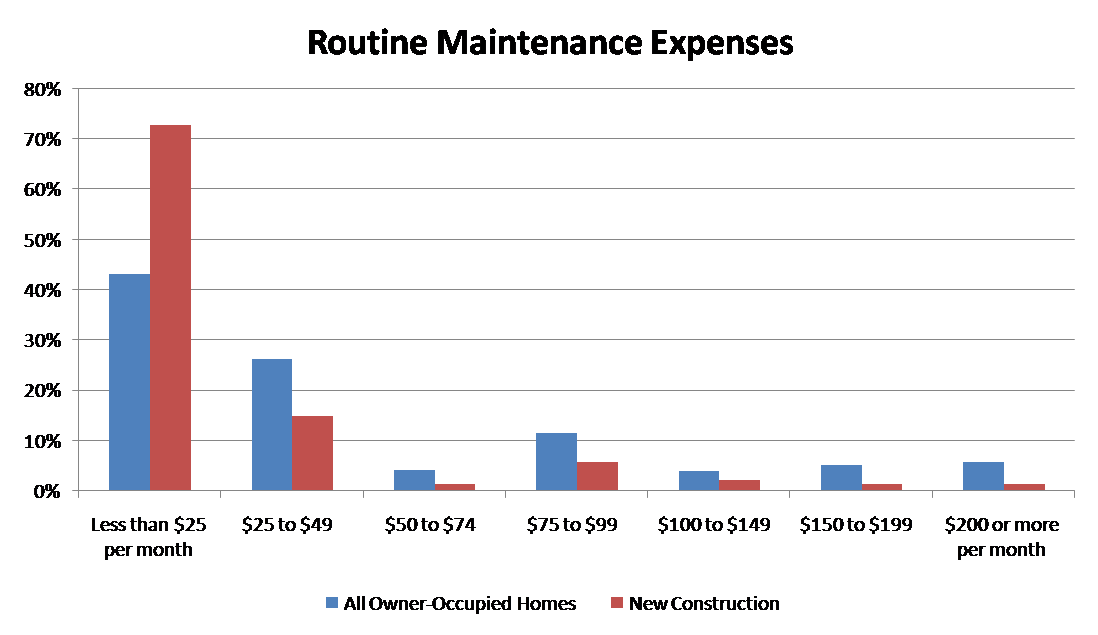
For example, for routine maintenance expenses, 26% of all homeowners spent $100 or more a month on various upkeep costs. However, only 11% of owners of newly constructed homes spent this amount. In fact, 73% of new homeowners spent less than $25 a month on routine maintenance costs.

Similar findings are available for energy expenses. On a median per square foot basis, homeowners spent 78 cents per square foot per year on electricity. Owners of new homes spent 65 cents per square foot per year.
For homes with piped gas, homeowners spent on average 53 cents per square foot per year. Owners of new homes spent 38 cents per square foot per year.
These data highlight that a new home offers savings over the life of ownership due to reduced operating costs. This is one of the many reasons that the current system of appraisals needs updating to reflect the flow of benefits that come from features in a new home.
  1. [...] National Association of Home Builders recently reported that the majority of new homeowners (about 73% according to the 2009 American Housing Survey) spend [...]
  2. excellent information, we’ve been preaching this for years; great to have third party confirmation.
  3. [...] New Homes are Less Expensive to Maintain « Eye on Housing Posted by Chad Johannesen on April 9, 2012 in Uncategorized with No Comments YetNew Homes are Less Expensive to Maintain « Eye on Housing. [...]
  4. Ron Struthers says:
    A better deal than a Chevy. Volt
    Lasts longer and it’s yours
  5. [...] of your new home. But, did you know that new homes can also help you save money? According to a NAHB Eye of Housing article, new homes are less expensive to [...]
  6. [...] of the best benefits is that a brand new home can help you save money. According to a article by NAHB Eye on Housing, new homes are much less expensive to [...]


Friday, February 10, 2012

Stay at Home Preferred Choice

In case you have been anticipating what your future holds in your housing needs, check out this article below published from the International Home Builders Show in Orlando this week..

NAHB
Market for Aging-in-Place Remodeling Goes Mainstream as More Home Owners Prefer to Remain at Home
February 9, 2012 - The market for aging-in-place remodeling continues to grow as more homeowners choose to remain in their homes as they age, according to the National Association of Home Builders (NAHB). NAHB Certified Aging-In-Place Specialists (CAPS) experts were joined by representatives from AARP today for a press conference held at the International Builders’ Show (IBS) to discuss how the aging-in-place market has changed as it moves mainstream, what consumers are looking for and what universal design and aging-in-place trends will be popular in the future.
Nine out of 10 people age 50 and older say they want to remain in their homes and communities for as long as possible. “As the first baby boomers turn 65 this year, CAPS professionals in remodeling and other industries are providing the expertise these families need to stay in their homes safely and in style,” said Scott Sevon, CAPS, GMR, GMB, CGP, 2012 chair of the CAPS Board of Governors and a remodeler from Palatine, Ill. “This generation is typically healthier and wealthier than previous generations of similar age and expects their homes to reflect their active, independent and upscale lifestyles.”
Since the creation of the CAPS designation program 10 years ago, the aging-in-place market continues to grow as families plan to age in their homes or address acute needs. While the majority of CAPS consumers are 55-64 years of age, remodelers report that 23 percent of clients are younger (45-54 years of age) and planning ahead to age-in-place.
“We are proud that in its tenth year, CAPS continues to be the industry benchmark for aging-in-place remodeling in the industry,” said 2012 NAHB Remodelers Chairman George “Geep” Moore, Jr., CGR, CAPS, GMR, a remodeler from Elm Grove, La. “As aging-in-place modifications and universal design move into the mainstream, the CAPS designation program continues to provide accessibility, safety and low maintenance living to home owners of any age.”
The CAPS program was launched by NAHB in partnership with AARP, the NAHB Research Center and the NAHB 50+ Housing Council in 2002 and has been on the leading edge of home modifications for aging-in-place since its inception. The program has graduated more than 4,000 specialists in 10 years.
In 2011, NAHB introduced a new course, Universal Design/Build, that focuses on integrated home design features and product specifications that account for client differences due to circumstance, physical characteristics, health issues and aging. Universal Design/Build expands on the previous CAPS courses by highlighting the successful integration of universal design into all residential construction projects.


We have been providing these amenities and cutting edge design in our new homes for over 6 years.  If you would like to learn more about sustainable, Green and Accessible Homes give us a call or set up a consultation.  

319-553-1457
Craig@CraigFairbanksHomes.com

Certified Aging in Place Specialist  NAHB
Certified Green Building Professional NAHB

Thursday, February 9, 2012

Not So Big House

I have followed Susan Susanka for many years with her not so big house materials and design ideas. Many of our past customers have used some of her design ideas and materials in the books she has written.

Now you can have an opportunity to view her ideas on a special website. The link is listed below to her magazine on the designs and homes that she builds.

The below listed information is provided by the not so big house and is copywrited

An Opportunity to Experience
A Not So Big House Firsthand

Sarah Susanka

Over the past year I've been working on a project that is the realization of a dream I've had since writing my first book, 14 years ago. It's a Not So Big Showhouse that's open to the public for an extended period -- a full 3D walk-through demonstration of all the principles I've described in my books. The Showhouse is located in Libertyville, Illinois, and it is open every weekend until May 20th, 2012, Sat 9-4, and Sun 1-4. So far over 4,500 people have visited, and I'm thrilled by those numbers. But I want to make sure that everyone who has always wanted to try on a Not So Big House, and everyone who is interested in experiencing a better floor plan for the way we really live, hears about this opportunity. If you are one of those people, I hope you will visit the Showhouse. I also hope you will share this information with anyone you think would be interested.


Links belowa provide the full magzine

http://campaign.r20.constantcontact.com/render?llr=upvki6bab&v=001E6oef0cghO_tnfQb5Aa1vDQ-6SzngU9kh6oD33GRX7agnYLzBThMlUG8qZcIz3qp4ptzqqaCciWbttOP72LscXboGTs_kLqqqaw3AXi8lrK39WwW_vCwsjThTIAED6ZU


Happy Home Dreaming

Saturday, January 28, 2012

Housing Cost vs. Value Report

DON'T IMPROVE YOUR HOME 
  UNTIL YOU READ THIS EYE OPENING REPORT

Ever wonder if a home improvement to your home will pay for itself at selling time.  Take the guess work out of those decisions and don't make a move without reading this valuable report.


Remodeling Magazine Feature report at  www.costvsvalue.com

Cost vs. Value Report data:  INSTRUCTIONS   If you are from Iowa you will need to choose Iowa and then Des Moines for the figures.  You will also have to register as a consumer in order to access the report..

These are always interesting and informative information as to what has value and what does not.  Many times it tells you whether to improve your current home or save your money and build a new home that has the features you were looking for.

Questions about this report?

Craig Fairbanks
Craig@CraigFairbanksHomes.com
319-553-1457


COPYRIGHTED MATERIAL
The Remodeling Cost vs. Value Report contains copyrighted material
that is being made available in free downloadable PDF documents
as a public service. Any reuse without express permission is
prohibited, including but not limited to the following:ig